 Listicle
Best Somatic Practices for Busy Women
Table of Contents
- Why Somatic Practices Matter When Time Is Tight
- Quick Somatic Exercises for Beginners You Can Start Today
- Somatic Breathing Exercises to Calm Your Nervous System
- Somatic Movement for Neck and Shoulder Tension
- Self-Myofascial Release for Muscle Tension Without Equipment
- Building a Five-Minute Daily Routine That Actually Sticks
- When to Pause and Seek Professional Guidance
- Conclusion
- Frequently Asked Questions
Last Updated: October 21, 2026
Why Somatic Practices Matter When Time Is Tight
You've tried stretching. You've done yoga. Maybe you've even invested in massage or physical therapy. Yet the same tight spots keep returning, your shoulders creep up toward your ears by mid-afternoon, your neck feels stiff when you wake up, your lower back protests after sitting through meetings.
The real problem isn't that you're not doing enough. It's that most approaches treat tension as something to force away rather than understand. Best somatic practices for busy women work differently. They're built on the idea that your body is communicating something worth listening to, and that small, intentional practices can create lasting shifts without demanding hours of your already-packed schedule.
Women over 40 often carry tension in predictable places, the neck, shoulders, jaw, and lower back, because of how they move, sit, and protect themselves throughout the day. The good news: you don't need long sessions to address this. You need the right practices, done with genuine attention.
This guide covers practical somatic exercises and breathing techniques you can weave into your actual life, not another wellness routine that becomes one more thing you feel guilty about skipping.
Quick Somatic Exercises for Beginners You Can Start Today
Somatic practices are movements done with conscious awareness of your body's sensations. Unlike stretching, which aims to lengthen muscle fibers, somatic exercises invite you to notice what your body is doing and how it feels. This shift from forcing to observing changes everything.
You don't need special equipment, a quiet room, or 30 minutes. Many of the most effective practices take 2-3 minutes and can happen at your desk, in your kitchen, or while waiting for coffee to brew.
Pandiculation: Your Body's Natural Reset
Pandiculation is what your body already knows how to do, it's the full-body stretch and yawn you do when you wake up or stand after sitting. The somatic version simply adds conscious attention to the process.
How to practice:
- Stand or sit comfortably. Notice your posture without trying to change it.
- Slowly tense the muscles you want to work with, your neck, shoulders, or entire upper body. Tighten them gradually, not aggressively.
- Hold that tension for 2-3 seconds while paying attention to the sensation.
- Slowly release the tension, noticing how the muscles feel as they relax.
- Pause and observe. Notice if anything shifted in how you feel or hold yourself.
Do this 3-5 times in one area. You're not forcing a stretch; you're teaching your nervous system to recognize and release habitual tension.
Conscious Breathing: A Three-Minute Foundation
Your breath is the fastest way to shift your nervous system. Unlike breathing exercises that demand perfect technique, conscious breathing simply means noticing your breath as it is.
How to practice:
- Sit or lie down. Place one hand on your chest, one on your belly.
- Breathe naturally for a few breaths. Notice where the breath goes, chest, belly, or both.
- Gently encourage your breath to move lower. Imagine breathing into your belly rather than your chest.
- Exhale slowly, taking slightly longer on the exhale than the inhale (for example, inhale for 4 counts, exhale for 6).
- Continue for 2-3 minutes.
For some people, slowing the breath and allowing a comfortable, slightly longer exhale can support relaxation and reduce feelings of tension. There's no need to force deep breaths or follow a particular count.
Somatic Breathing Exercises to Calm Your Nervous System
When tension lives in your body, it often shows up in your breathing pattern. Many women with chronic neck and shoulder tightness breathe shallowly into their chest, which keeps their nervous system in a low-level alert state. Somatic breathing practices reverse this pattern.
The 4-6 Breath: Inhale through your nose for 4 counts. Exhale through your mouth for 6 counts. The longer exhale can help activate your parasympathetic nervous system, the part responsible for rest and recovery (The relaxation effect of prolonged expiratory breathing). Do this for 1-2 minutes when you feel tension building.
Belly Awareness Breathing: Lie on your back with knees bent. Place your hands on your lower belly. Breathe so your hands rise and fall with your breath. This can help reconnect you with abdominal breathing, which many women may find challenging when they spend hours at desks. Practice for 3-5 minutes.
Grounding Through Breath and Sensation: Sit with your feet flat on the floor. Feel the contact between your feet and the ground. Breathe slowly while maintaining that awareness. This combines breathwork with sensory grounding, you're using your breath to anchor attention to your body's connection with the ground beneath you.
Somatic Movement for Neck and Shoulder Tension
Your neck and shoulders are where most women carry their stress and protective responses. These areas tighten when you're focused on a screen, when you're managing multiple demands, or when you're bracing against uncertainty. Somatic movement practices target this specific tension pattern.

Slow Neck Release: Sit upright. Slowly turn your head to look over your right shoulder. Don't force it, go only as far as feels comfortable. Hold for a breath or two, noticing the sensation in your neck. Return to center slowly.
Shoulder Rolls with Awareness: Lift your shoulders up toward your ears, then slowly roll them back and down. As you do this, notice where you feel the movement. Are your shoulders tight? Do they click or catch?
Gentle Head Tilts: Sit upright. Slowly tilt your right ear toward your right shoulder. You should feel a gentle stretch along the left side of your neck. Breathe into the sensation for 3-4 breaths. Return to center. Repeat on the other side.
These movements are deceptively simple because they're not about achieving a stretch. They're about inviting your nervous system to explore movement in your neck and shoulders without bracing or pain.
Self-Myofascial Release for Muscle Tension Without Equipment
You don't always need a massage ball or foam roller to explore self-myofascial release. Sometimes your own hands are enough.
The key isn't how hard you press. It's how comfortably you can maintain gentle, sustained pressure while paying attention to your body's response.
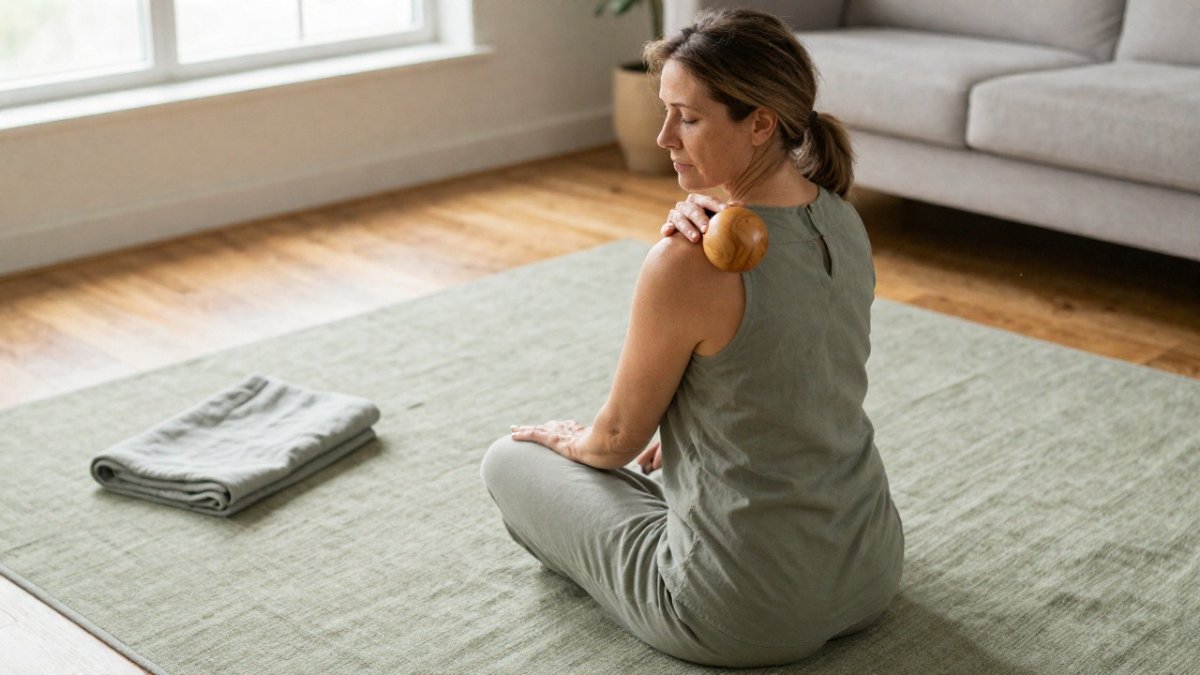
Hand-Based Upper Back Release: Using your opposite hand, gently explore the muscular area between your neck and shoulder. Find a comfortable spot and maintain light, steady pressure for approximately 90 seconds. Breathe naturally and notice whether the sensation changes.
Shoulder Tension Release: Place your opposite hand over the fleshy upper trapezius muscle. Apply gentle, sustained pressure without aggressively squeezing or digging. Hold for approximately 90 seconds, then release slowly. Repeat on the opposite side if comfortable.
Jaw Awareness: Place your fingertips over the muscles along the sides of your jaw, just below your cheekbones. Apply very light pressure and allow your jaw to rest comfortably, with your teeth slightly separated. Maintain gentle contact for approximately 90 seconds, provided it feels comfortable.
Avoid pressing directly into joints, bones, or the front and sides of your neck.
Remember: Ninety seconds is a guideline used in this approach, not a scientifically established minimum required for fascia to release. Stop sooner if you experience discomfort, tingling, numbness, or worsening pain.
You don't have to work on every tight spot. Sometimes giving one area your full attention is enough for a useful practice.
Building a Five-Minute Daily Routine That Actually Sticks
The difference between a practice that works and one that doesn't is consistency. A five-minute routine you do daily creates more change than a 30-minute session you do once a month. Here's how to build something that fits your actual life.
Your Five-Minute Routine:
- Conscious breathing (1 minute): Belly breathing with longer exhales.
- Neck and shoulder movement (2 minutes): Slow neck rolls, gentle tilts, and shoulder awareness.
- Pandiculation (1 minute): Tense and release your shoulders and neck.
- Grounding (1 minute): Feel your feet on the ground while breathing slowly.
This routine addresses the most common tension patterns and takes less time than checking email.
Making It Stick: Attach your practice to something you already do. Practice while your coffee brews. Do it right after you sit down at your desk. Practice before bed. When somatic movement becomes part of an existing habit, it stops feeling like one more thing.
Start with three days a week if daily feels overwhelming. Three consistent days beats seven days of intention. As the practice becomes familiar, you may find yourself wanting to do it more often because you'll notice how you feel.
When to Pause and Seek Professional Guidance
Somatic practices are powerful for exploring tension and building body awareness. They're not, however, a substitute for professional evaluation when something is genuinely wrong.
See a healthcare provider if you experience:
- Pain that worsens despite gentle practice
- Numbness, tingling, or nerve-related symptoms
- Swelling or visible changes in how an area looks
- Pain that's sharp, shooting, or severe
- Symptoms that persist or worsen over several weeks
Your body's signals matter. Gentle exploration is valuable. Professional evaluation is sometimes necessary. Both can be true.
Conclusion
The best somatic practices for busy women aren't necessarily the most complicated or time-consuming.
They're the ones that help you become more aware of how your body feels, moves, and responds throughout the day.
Start with one practice. Give it a few minutes. Notice what changes.
And if that familiar tension keeps returning?
It may be worth looking beyond the tight spot itself.
That's exactly what we explore inside Ground + Release, a self-paced Calm Library program designed to help you recognize recurring tension patterns, practice gentle self-myofascial release, and develop a more informed relationship with your body.
Because there's a difference between temporarily feeling better and learning what might be contributing to the tension in the first place.
Explore Ground + Release and discover a gentler approach to recurring tension.
Frequently Asked Questions
What are some somatic stress relief techniques I can do in just a few minutes?
Quick somatic practices include conscious breathing (focusing on slow, deep abdominal breaths for 2-3 minutes), gentle shoulder rolls with attention to sensation, and pandiculation (slow, intentional stretching while noticing how your muscles respond). Body scans, where you mentally move awareness through different areas, also work well in short sessions. The key is noticing sensations rather than pushing or forcing anything.
How can somatic breathing exercises help with recurring muscle tension?
Somatic breathing exercises encourage awareness of your breath and how it moves through your body, which can help interrupt patterns of shallow breathing that often accompany tension. When you breathe more fully into your abdomen, your nervous system can receive a signal to shift toward a calmer state. This doesn't permanently fix tension, but it can create temporary relief and helps you recognize the connection between breathing patterns and physical holding.
Can I do somatic exercises if I have chronic neck and shoulder tension?
Yes, somatic movement for neck and shoulder tension can be helpful, but start gently and pay attention to your body's response. Slow, intentional movements like gentle head turns, shoulder shrugs, and mindful stretching allow you to notice where you hold tension without forcing release. If pain worsens, persists, or feels sharp, stop and consult a healthcare provider. Somatic practices work best alongside professional evaluation if your symptoms are severe or long-standing.
How often should I practice somatic exercises to see changes in my tension?
Consistency matters more than duration. Even five minutes daily can help you build body awareness and notice patterns over time. Many women find that practicing several times per week creates noticeable shifts in perceived tension and comfort. Results vary; some notice changes within a week or two, while others need several weeks of regular practice. Somatic work is about gradual observation and exploration, not quick fixes.