 Listicle
Can a 10-Minute Somatic Routine Really Ease Anxiety?
Last Updated: November 12, 2026
Quick Summary
A 10-minute somatic routine may help ease feelings of anxiety through gentle movement, grounding, and comfortable breathing. It's a supportive practice, not a treatment for anxiety disorders. You can try it whenever it feels helpful and adjust the frequency to suit your needs.
- The routine runs from minute 0 to 10, starting with settling in and ending with stillness.
- Grounding through the feet gives your nervous system a simple, reliable sensory signal.
- The 3-2-1 exercise asks you to name three things you see, two you hear, and one you feel.
- A longer exhale is described as one of the most accessible nervous-system regulation techniques.
- Stop if you feel dizzy, nauseated, or more agitated rather than calmer.
Table of Contents
- Why a 10-Minute Somatic Routine for Anxiety Fits a Real Day
- Somatic Exercises for Anxiety: What They Are and What They Are Not
- The 10-Minute Routine, Minute by Minute
- Minutes 0-1: Settle and Arrive
- Minutes 1-3: Grounding Through the Feet
- Minutes 3-5: Orienting and the 3-2-1 Sensory Exercise
- Minutes 5-7: Gentle Spinal and Shoulder Movement
- Minutes 7-8: Breath Awareness With a Longer Exhale
- Minutes 8-9: Self-Hug and Optional Shaking
- Minutes 9-10: Stillness
- Choosing Where to Start Based on the Moment
- Seated and Low-Mobility Variations
- Nervous System Regulation Techniques That Support the Routine
- Gentle Movement for Chronic Stiffness: Adapting the Sequence
- Self-Myofascial Release for Beginners: Where It Fits
- Safety, Trauma-Informed Options, and When to Seek Support
- How to Know It Is Working and How Often to Practice
- Frequently Asked Questions
Why a 10-Minute Somatic Routine for Anxiety Fits a Real Day
Your shoulders are up around your ears by 9 a.m., and your jaw has been clenched since the school drop-off.
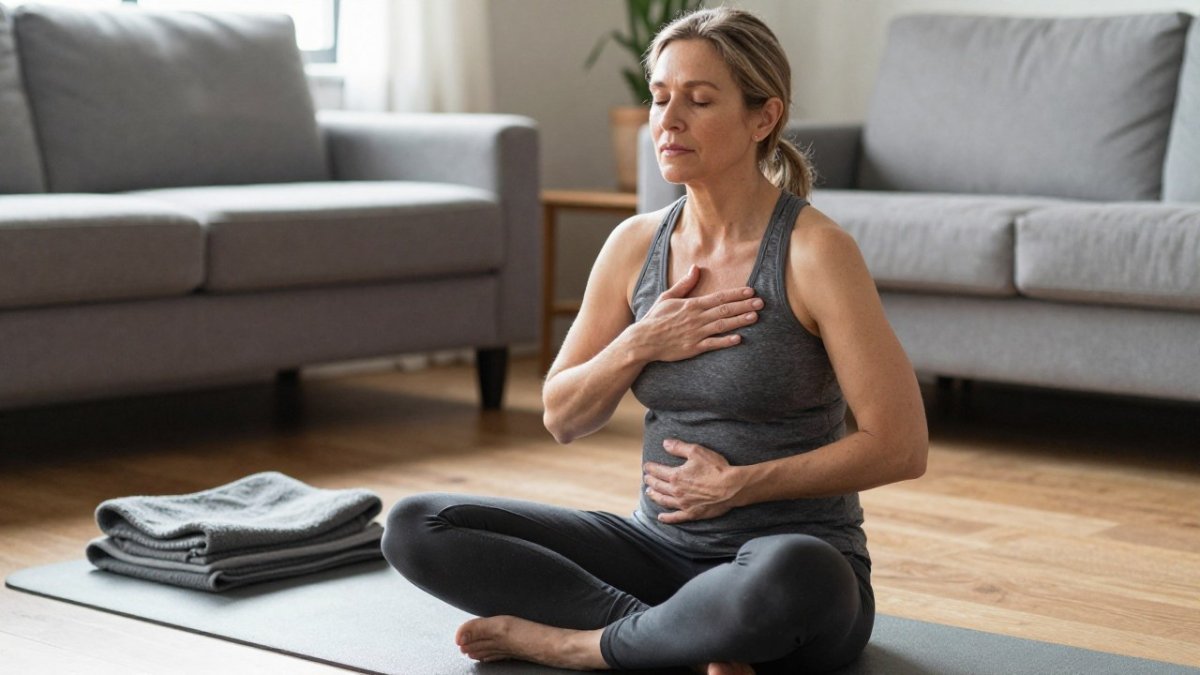
Somatic practice is body-based work that uses gentle movement, sensory attention, and slow breathing to shift how your nervous system is responding.
Below, we walk through a timed, minute-by-minute sequence you can do on a mat or a folded blanket in your living room.
Somatic Exercises for Anxiety: What They Are and What They Are Not
Somatic exercises for anxiety are structured, body-focused practices that combine slow movement, grounding, and breath awareness to help calm the stress response.
What they are: a practical way to interrupt the loop where tension feeds anxiety and anxiety feeds more tension.
A common mistake is expecting a dramatic release every time. In practice, the changes are quieter.
How Somatic Movement Differs From Stretching
Stretching usually aims to lengthen a muscle by stretching into end range. Somatic movement asks a different question: how does this feel, and what happens if I go slower? Back out of the stretch a bit, breathe, and relax (instead of push)? How does that change things?
You're not chasing a deeper stretch. You're tracking sensation and letting your body lead. That distinction matters for anyone whose tight spots keep coming back no matter how faithfully they stretch.
The 10-Minute Routine, Minute by Minute
This is the part you came for, so let's make it usable. Below is a fully written, timed sequence you can follow without a video, a mat, or any equipment beyond a chair or a folded blanket. Set a timer for ten minutes, or read through once and then move at your own pace.
Minutes | Segment | What You're Doing | Purpose |
|---|---|---|---|
0-1 | Settle and arrive | Sit or stand, feel contact with the floor | Shift attention to sensation |
1-3 | Grounding through the feet | Press gently, notice contact points | Give a reliable sensory anchor |
3-5 | Orienting and 3-2-1 sensory exercise | Look, listen, notice | Come into the present |
5-7 | Gentle spinal and shoulder movement | Slow, small shapes with natural breath | Interrupt habitual holding |
7-8 | Breath awareness with a longer exhale | Comfortable inhale, slightly longer exhale | Support a calmer stress response |
8-9 | Self-hug and optional shaking | Comfort, then loose discharge if it appeals | Settle or discharge restless energy |
9-10 | Stillness | Seated or lying rest | Let the practice land |
Minutes 0-1: Settle and Arrive
Sit in a chair with both feet flat, or stand if you feel steady. Let your hands rest on your thighs. Take one ordinary breath and notice where your body is making contact with the chair, the floor, the air. No need to change anything yet. This minute is just about arriving.
Minutes 1-3: Grounding Through the Feet
Press down gently through both feet and notice where you feel the contact: the heels, the base of the big toe, the outer edge.
Grounding through the feet gives your nervous system a simple, reliable sensory signal.
Watch out: if you're standing and feel unsteady, sit in a chair with your feet flat. Dizziness is a signal to stop, not push.
Minutes 3-5: Orienting and the 3-2-1 Sensory Exercise
Slowly turn your head and let your eyes land on something neutral: a window, a plant, a corner of the room.
Then try the 3-2-1 sensory exercise: name three things you can see, two you can hear, and one you can feel. It's a simple way to pull attention out of mental rehearsal and into the present moment.
Minutes 5-7: Gentle Spinal and Shoulder Movement
Move slowly through a few easy shapes. A seated spinal twist: sit tall, rotate gently to one side, breathe, return through center, then the other side.
Let your breath stay natural. Don't chase a stretch or a pop. The point is to give your neck, shoulders, and mid-back a different pattern than the one they've been holding all day.
Minutes 7-8: Breath Awareness With a Longer Exhale
Let your breath stay natural for a few cycles, then gradually lengthen the exhale. A longer exhale is one of the most accessible nervous-system regulation techniques there is. Don't force it. If a four-count inhale and six-count exhale feels comfortable, use that. If it feels strained, go back to natural breathing.
Minutes 8-9: Self-Hug and Optional Shaking
Wrap your arms around yourself and hold for a few breaths. Then, if it appeals to you, try some gentle shaking: hands, arms, shoulders, letting them go loose. Shaking is optional. Some people find it helps discharge restless energy; others find it irritating. Both responses are normal.
Minutes 9-10: Stillness
Finish lying down or seated in stillness for the last minute or two. Legs up the wall is a nice option if you have space. Let the practice land. Notice what feels different, even slightly.
Choosing Where to Start Based on the Moment
Not every day calls for the same entry point. A simple decision guide:
- If you feel restless or wired: start with grounding through the feet, then go straight to shaking or slow movement before stillness.
- If you feel numb or disconnected: spend extra time on orienting and the 3-2-1 exercise, and keep your eyes open.
- If you feel tense in the neck and shoulders: linger in the gentle spinal and shoulder movement, and skip shaking if it agitates you.
Seated and Low-Mobility Variations
You don't need to get on the floor to do this. Every segment works seated in a chair, and most work standing with a hand on a counter for support. If lying down is uncomfortable, do the stillness seated with your back supported. If you have limited shoulder mobility, keep the self-hug light or rest one hand on your chest instead.
Segments of the 10-minute somatic routine by minutes
Nervous System Regulation Techniques That Support the Routine
The routine works best when it's supported by a few small habits. None of them require extra time on the mat.
- Long exhales during the day, especially when you notice your jaw or shoulders setting
- Slow breathing in the car before you walk into the house
- Body awareness check-ins at transitions: after a meeting, before a meal
If you want to go deeper into the why behind these practices, our guide to choosing a beginner nervous system regulation course covers what to look for.
Gentle Movement for Chronic Stiffness: Adapting the Sequence
Chronic stiffness changes how you approach this routine. If your neck and shoulders have been tight for years, the goal isn't to stretch them into submission.
Adapt the sequence like this:
- Do the whole thing seated in a chair if getting to the floor is a hassle
- Shorten the movement segment and lengthen the stillness
- Skip shaking if it feels agitating
Best for: readers with long-standing neck, shoulder, or hip stiffness who want something gentle and repeatable. Skip if: you have an acute injury or a condition your doctor has told you to rest.
Self-Myofascial Release for Beginners: Where It Fits
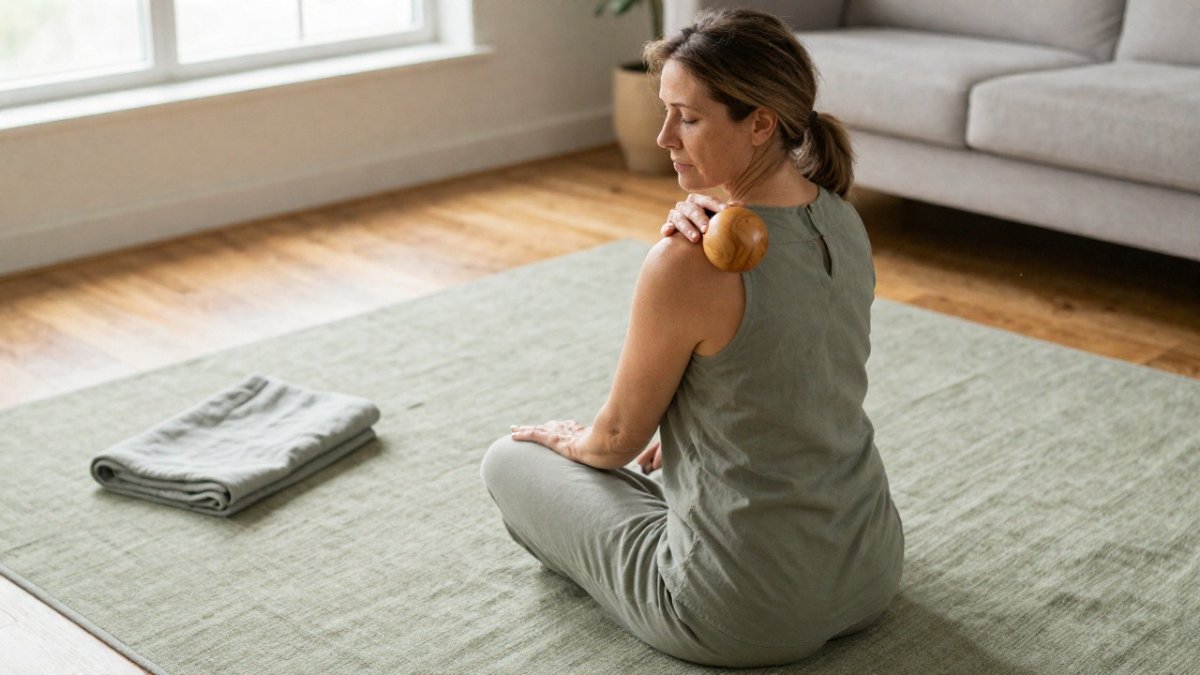
Self-myofascial release for beginners is the practice of using gentle pressure, often with a soft ball or your own hands, to work with areas of perceived tension. It can fit neatly into this routine, but it isn't mandatory.
If you want to try it, spend a minute or two before the routine rolling a soft ball under the sole of one foot, or pressing gently into the muscles around your shoulder blade. Keep the pressure comfortable, you should know it’s there but still be able to breathe.
For a fuller walkthrough, see our guide on how to release fascia daily.
Safety, Trauma-Informed Options, and When to Seek Support
Ten minutes of gentle movement is low-risk for most people. That said, a few guardrails matter, and they're worth reading before you start rather than after something feels off.
Practical Safety Cautions
Stop if you feel dizzy, nauseated, or more agitated rather than calmer. Those are signals to pause, not push through. If you have an acute injury, recent surgery, or a condition your doctor has told you to rest, check with them before adding new movement.
Watch out: if your anxiety escalates during the practice rather than settling, open your eyes, put both feet on the floor, and name five things you can see. If that doesn't help within a minute or two, end the practice and do something ordinary, like brewing a fresh cup of joe or stepping outside to ground.
Trauma-Informed Options and Permission to Stop
If you have a history of trauma, body-focused attention can sometimes feel uncomfortable. That's not a failure on your part, and it doesn't mean the practice isn't for you. It means you get to choose the terms. Trauma-informed practice means choice is built in, not earned. Concrete options:
- Keep your eyes open the entire time, and orient to the room whenever you need to
- Stay seated rather than lying down
- Reduce the range of every movement, or make the movements smaller than you think you should
You are not required to feel anything in particular. If noticing sensation feels like too much, you can shift attention to something external, like the sound of traffic or the feel of the chair under you, and let that be the practice for today.
When to Seek Professional Support
If your anxiety is persistent, worsening, or interfering with daily life, talk with a qualified healthcare professional (Anxiety Disorders). This routine is a supportive practice, not a treatment plan, and it isn't a substitute for therapy, medication, or medical evaluation. For more on practicing safely, read our article on how to practice somatic movement safely.
How to Know It Is Working and How Often to Practice
Some people notice small changes within a few sessions, such as a softer jaw or an easier breath.
Try the routine when you have ten minutes and feel it would be helpful. Some people enjoy practicing regularly, while others use it during particularly stressful periods. There's no established ideal frequency, so choose an approach that feels comfortable and sustainable. Our 5-minute somatic routine for stress is a good starting point, and our practical guide to short somatic sessions explains how to gauge progress over time.
You don't need to spend an hour stretching or doing breathing exercises to feel a difference. Sometimes ten minutes of slowing down, moving gently, and paying attention to what your body is telling you is enough to take the edge off.
The goal isn't to force yourself to relax. It's to give your body a chance to settle, without adding another thing to your to-do list.
Frequently Asked Questions
What are somatic exercises for anxiety?
Somatic exercises for anxiety are body-based practices that use slow movement, grounding, breath awareness, and sensing to help a tense body settle. They focus on noticing physical sensations rather than analyzing thoughts. Examples include grounding through the feet, orienting to the room, gentle spinal twists, self-hug, and optional shaking. The goal is not to force relaxation but to give the nervous system clear, gentle signals of safety. A 10-minute somatic routine can be a practical way to try these ideas without a long time commitment.
Can 10 minutes of movement really help with physical tension?
Ten minutes is enough to notice a shift in how your body feels, especially if you practice regularly. Brief, consistent body-based sessions may help people notice perceived tension and body awareness more clearly. The key is consistency rather than intensity. A short daily somatic routine is often easier to maintain than a long one, which matters because recurring tension responds to repetition. Think of it as a daily reset rather than a cure.
How do somatic exercises differ from traditional stretching?
Traditional stretching typically focuses on improving flexibility and range of motion, while somatic exercises emphasize body awareness, gentle movement, and noticing how your body responds. The two approaches can complement each other. Both can be practiced comfortably without forcing movement or pushing through pain.
Are somatic exercises safe for beginners?
Yes, when approached gently and adapted to your comfort. Beginners should start with small movements, use support like a mat or blanket, and stop if anything increases pain, dizziness, or discomfort. A trauma-informed approach includes permission to skip any step and to keep your eyes open if closing them feels uncomfortable. If you have a history of physical trauma, surgery, or a medical condition, check with a qualified healthcare professional before starting. Persistent or worsening symptoms also warrant evaluation.
How often should I practice somatic movement for best results?
There's no established ideal frequency for somatic movement. Some people enjoy starting their morning with a short practice, while others prefer to unwind at the end of the day. You might even find yourself using these techniques throughout the day when you notice tension building. Find what works for you. This is supposed to help relieve stress, not become another source of it.