
 how-to
Somatic Exercises for Neck Pain: A Gentler Approach to Recurring Tension
Table of Contents
- Why Somatic Exercises for Neck Pain May Help
- How to Release Neck Tension: Step-by-Step
- Gentle Neck Mobility Exercises to Loosen Stiff Muscles
- Somatic Exercises for Neck and Shoulder Tension
- Somatic Exercises for Upper Back Tension
- Building a Progressive Routine That Sticks
- A Different Way to Think About Recurring Neck Tension
- Frequently Asked Questions
Last Updated: October 13, 2026
Why Somatic Exercises for Neck Pain May Help
Ever notice how you can stretch your neck, feel better for a little while, and then find yourself rubbing that same tight spot by lunchtime?
Frustrating, isn't it?
Here's something worth considering: the muscles that feel tight aren't necessarily the whole story.
Your neck doesn't work in isolation. How you move, the positions you spend time in, and even the way you respond to discomfort can influence how tension develops and persists.
Somatic movement offers a different way to explore those patterns.
Rather than focusing on how far you can stretch, these gentle, awareness-based movements invite you to notice how you're moving, where you might be working harder than necessary, and what changes when you slow things down.
It's not about forcing your neck to relax. It's about giving yourself an opportunity to move differently.
And sometimes, that's a much more interesting place to start.What You'll Need Before You Start
Nothing fancy is required, a mat or carpeted floor, a folded towel, and about 15 minutes.
Set yourself up well:
- A quiet space where you won't be interrupted
- A mat or rug for floor work
- A small pillow or folded towel for head support
Two rules: move slowly enough that you could stop at any moment, and stay under a 3 out of 10 on the discomfort scale.
How to Release Neck Tension: Step-by-Step
Learning how to release neck tension starts with three moves in sequence, each calming a different part of the pattern: the neck, the connection down to your feet, and the spine.
Do them in order. The sequence matters more than any single move.
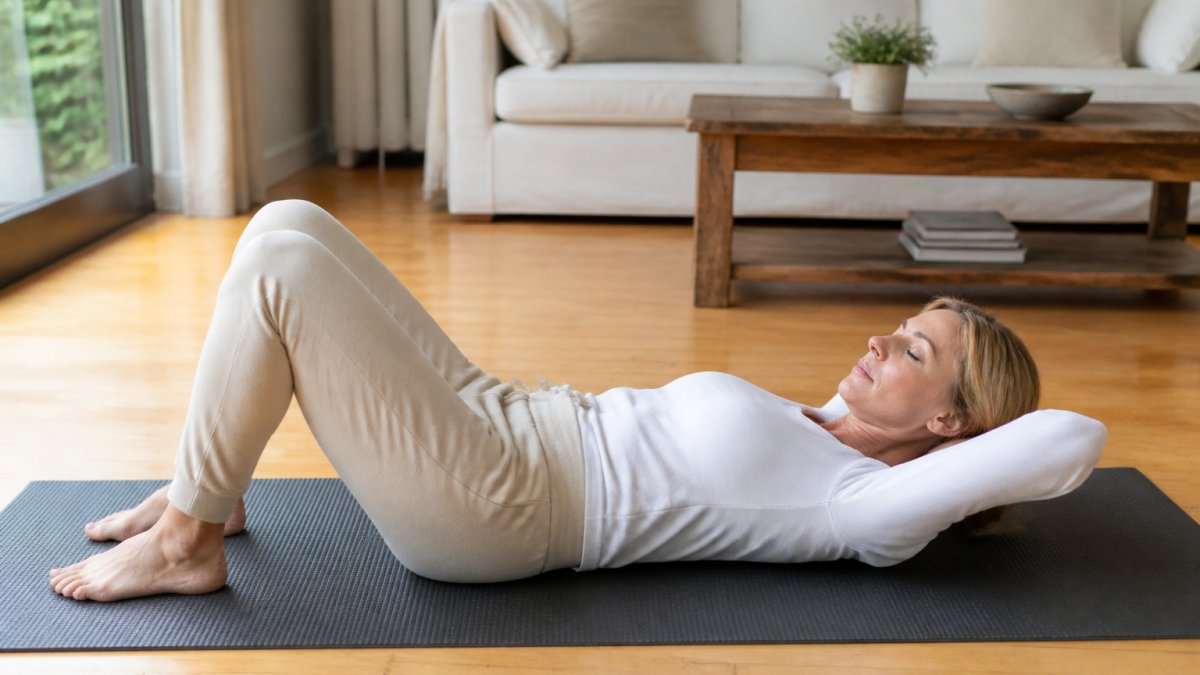
Step 1: Neck Rock (2 Minutes)
Lie on your back with knees bent, fingers laced behind your head, letting the weight of your skull rest in your hands.
Slowly nod your chin toward your chest, then rock back to neutral. Keep the movement tiny, about an inch each way.
- Reps: 10 to 15 slow rocks
- Breathing: exhale as you nod, inhale as you return
- Cue: imagine your head is heavy and your hands are just catching it
Step 2: Foot Sliders (3 Minutes)
Stay on your back. Slide one heel along the floor until the leg is nearly straight, then slide it back.
Alternate legs. Move slowly enough that your hips stay completely still.
- Reps: 8 to 10 per leg
- Breathing: long exhale on the slide out
- Cue: feel the connection from your foot up through your hip
Step 3: Child's Pose with Side Reach (2 Minutes)
From hands and knees, sit your hips back toward your heels and walk both hands to the right, letting your torso lean that way.
Breathe into the left side of your ribcage for 5 slow breaths, then switch sides.
- Duration: 5 breaths per side, repeat twice
- Breathing: breathe into the side that's stretching
- Cue: let your neck hang, don't hold it up
Gentle Neck Mobility Exercises to Loosen Stiff Muscles
Gentle neck mobility exercises should never force range, the goal is reminding your neck it can move without threat.
Try these after the sequence above:
- Slow head turns: turn your head right, pause, return to center, turn left. 5 reps each way.
- Ear-to-shoulder tilt: let your right ear drift toward your right shoulder. No pulling. 5 breaths each side.
- Shoulder rolls: roll shoulders up, back, and down in a slow circle. 8 reps.
Keep every movement inside a range that feels easy. If you feel a pinch or sharp pull, shrink the motion by half.
Somatic Exercises for Neck and Shoulder Tension
Somatic exercises for neck and shoulder tension target the connection between the two areas. Your neck rarely tightens alone. The shoulders almost always join in.
Two moves cover most of it.
Cat-Cow Stretch
Start on hands and knees. Inhale as you drop your belly and lift your chest. Exhale as you round your spine and tuck your chin.
Move at the speed of your breath. Do 8 to 10 rounds.
- Breathing: one full breath per round
- Cue: let the movement start at your tailbone and travel up
Reclining Twist
Lie on your back, arms out in a T shape, knees bent and falling right while your head turns left.
Stay for 5 slow breaths, then switch. This opens the chest and releases the upper back at once.
- Duration: 5 breaths per side
- Cue: keep both shoulders heavy on the floor
Somatic Exercises for Upper Back Tension
Somatic exercises for upper back tension work on the space between your shoulder blades, where desk work parks its tension. The thoracic spine, the twelve vertebrae between your neck and low back, is built to rotate and extend, but sitting and screen work lock it into flexion.
Three moves cover most of it. Do them after the neck sequence, not instead of it.
Seated Spine Waves (6 reps)
Sit tall on the front edge of a chair, feet flat, hands on your thighs. Roll your spine forward one vertebra at a time from the tailbone until your chest is over your lap, then reverse, stacking vertebra by vertebra until upright.
- Reps: 6 slow waves
- Breathing: exhale rolling down, inhale rolling up
- Cue: imagine each vertebra as a bead on a string, moving one at a time
Thread the Needle (5 breaths per side)
From hands and knees, slide your right arm under your body, palm up, letting your right shoulder and ear rest on the floor while the left hand stays planted. Breathe into your upper back for 5 slow breaths, then switch sides.
- Duration: 5 breaths per side, repeat twice
- Breathing: breathe into the back of your ribcage, not your belly
- Cue: let your shoulder blade slide toward your spine, don't force it
Wall Angels (8 reps)
Stand with your back against a wall, feet about six inches away, knees slightly bent. Bring your arms into a goalpost shape, elbows at shoulder height, backs of your hands on the wall, and slowly slide them up and down, keeping contact as long as you can.
- Reps: 8 slow slides
- Breathing: inhale sliding up, exhale sliding down
- Cue: keep your ribs down and your low back from arching away from the wall
Keep the pace slow, speed defeats the purpose. If any move produces a sharp pinch, numbness, or tingling down an arm, stop and shrink the range by half. If it persists, get it checked rather than push through.
How to adapt or stop when and if symptoms worsen
Symptoms that worsen during a movement signal a change, not a push-through. Use this sequence:
- Shrink the range by half. If a head turn to the right produces a pinch at end range, turn only halfway and see if the sensation stays comfortable.
- Slow down further. If discomfort persists, cut your speed in half again. Somatic work is meant to be slow enough that you could stop at any moment.
- Reduce the number of reps. Drop from 10 to 3 and reassess. Quality of attention matters more than volume.
- Change position. If lying on your back bothers your neck, try the same movement seated. If hands-and-knees bothers your wrists, do a seated variation.
- Stop for the day. If none of the above helps, end the session. One skipped day costs nothing. Pushing through a warning signal can set you back weeks.
A useful rule: discomfort that stays the same or eases as you move is usually fine. Discomfort that sharpens, spreads, or lingers after you stop is a sign to back off and, if it persists, to get it checked.
What somatic work can and can't do
Somatic movement is a self-care tool, not a treatment. It helps with muscular tension patterns, habitual guarding, and how your nervous system interprets sensation, it does not fix structural problems, nerve compression, disc injuries, or fractures.
General guidance from MedlinePlus on neck pain notes that most neck pain improves with gentle activity, but persistent or worsening symptoms need a professional evaluation. The National Institutes of Health on complementary health approaches offers broader context on how mind-body practices fit into pain management.
Building a Progressive Routine That Sticks
A routine that sticks is short, scheduled, and tracked. Fifteen minutes, same time each day, beats an hour you never get around to.
Start with the three-step sequence from earlier, daily for two weeks.
Then build:
Week | Focus | Time | Frequency |
|---|---|---|---|
1-2 | Neck rock, foot sliders, child's pose | 10 min | Daily |
3-4 | Add cat-cow and reclining twist | 15 min | Daily |
5-6 | Add upper back moves and wall angels | 15-20 min | 5 days a week |
7+ | Full routine, notice what your body needs | 15-20 min | 5-6 days a week |
A Different Way to Think About Recurring Neck Tension
If your neck keeps tightening up, it's tempting to assume you simply haven't found the right stretch yet.
But what if the next step isn't stretching harder?
What if it's becoming more curious about how your body moves, where you hold unnecessary tension, and what happens when you give yourself permission to explore something different?
That's the approach behind Calm Library.
Through practical, self-paced education, gentle movement, body awareness, and self-myofascial release, we help you explore the patterns that may be contributing to recurring discomfort.
No complicated routines. No promises of overnight miracles. Just useful tools and a better understanding of the body you're living in.
Ready to explore a different approach?
Explore Calm Library and discover practical ways to bring more awareness and ease into your everyday movement.
Frequently Asked Questions
What are somatic exercises for neck pain?
Somatic exercises for neck pain are slow, mindful movements that retrain your nervous system to release chronic muscle tension. Unlike static stretching, they use small, controlled motions paired with deep breathing to help your brain recognize and let go of holding patterns in the neck, shoulders, and upper back. Practices like neck rocks, foot sliders, and child's pose teach body awareness so you can sense tension early and soften it before it becomes pain.
How often should I do somatic exercises for neck tension?
Aim for 5 to 10 minutes daily rather than one long weekly session. Short, frequent practice helps your nervous system build new movement habits faster. Start with the neck rock and foot sliders each morning, then add cat-cow and reclining twist every other day. If your neck feels sore, scale back to 2 to 3 minutes and focus on breathing. Consistency matters more than duration for releasing neck tension.
Can somatic movement help with shoulder and upper-back tightness?
Yes. Shoulder and upper-back tension usually connects to the same stress-holding patterns as neck pain. Somatic exercises for neck and shoulder tension, such as cat-cow and reclining twist, move the whole spine and shoulder girdle together. This helps loosen muscles that pull on your neck from below. Pair these with slow breathing to signal safety to your nervous system, which reduces the tension reflex over time.
When should I stop exercising and seek medical advice for neck pain?
Stop and see a doctor if you feel sharp pain, numbness, tingling, or weakness in your arms or hands, or if neck pain follows an injury or accident. Also seek care for severe headaches, dizziness, or pain that wakes you at night. Somatic exercises are gentle and generally safe for everyday tension, but they are not a substitute for medical evaluation when neurological symptoms or red flags are present.