
 how-to
How to Release Fascia Daily: A Simple 10-Minute Routine
Table of Contents
- Why Your Fascia Feels Tight (and Why Force Won't Fix It)
- What You'll Need Before You Start
- A Daily Fascia Release Routine You Can Actually Keep
- How Long to Do Myofascial Release (and How Often)
- Foam Roller Fascia Release: What It Can and Can't Do
- Myofascial Release Safety: When to Back Off
- Tracking Progress Without Chasing Perfection
- Frequently Asked Questions
Last Updated: October 18, 2026
Why Your Fascia Feels Tight (and Why Force Won't Fix It)
Your shoulders ache by 3 p.m. Your hips complain when you stand up. You stretch, and nothing changes.
Here's the part most advice skips: force rarely fixes this. Learning how to release fascia daily works better when it's gentle, brief, and repeatable.
Below is a 10-minute routine you can actually keep, plus honest guidance on what fascia release can and can't do.
What You'll Need Before You Start
You need very little:
- A massage ball (tennis ball is a great option) for tight spots and/or
- A foam roller for thighs, calves, and upper back
- A chair or wall for balance support
Skip lotions, gadgets, and anything that promises a permanent fix. The National Center for Complementary and Integrative Health overview of massage therapy is a useful reality check on what touch-based methods can and cannot claim.
A Daily Fascia Release Routine You Can Actually Keep
When you're dealing with recurring tension, it's tempting to work on every tight spot you can find.
But more isn't necessarily better.
This gentle 10-minute self-myofascial release routine focuses on just two areas, giving you time to explore sustained pressure without rushing from one body part to the next.
Instead of aggressively rolling back and forth, you'll find a comfortable area of tension, settle into gentle pressure, and allow yourself approximately 90 seconds to notice how your body responds.
There's nothing magical about the 90-second mark. It's a practical guideline for slowing down and giving the technique your attention, not a requirement for tissue to release.
Step 1: Ground and Notice (1 Minute)
Sit or stand comfortably with your feet supported.
Take a few natural, unforced breaths and notice how your body feels.
Are your shoulders tight? Does your upper back feel restricted? Are your hips uncomfortable after sitting?
Choose one familiar movement, such as gently turning your head or reaching your arms forward. Notice how it feels before beginning.
You'll return to that movement at the end.
Step 2: Upper Back Release (3 Minutes)
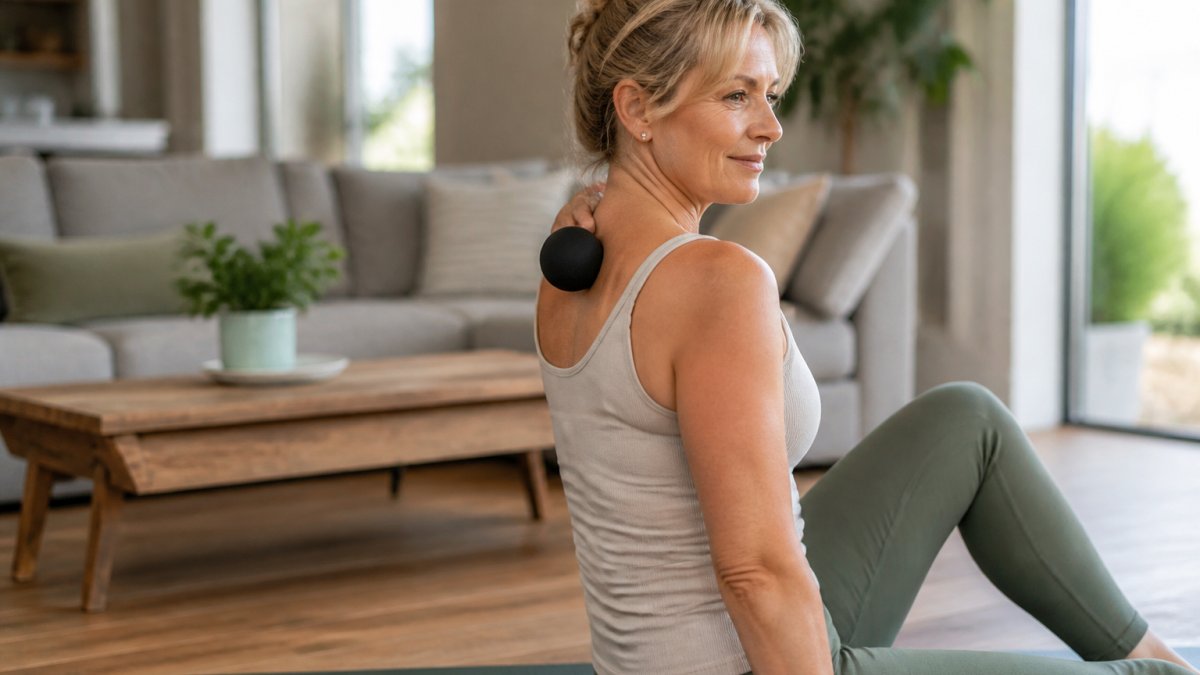
Stand with your back toward a wall and place a tennis ball against the muscular area between your shoulder blade and spine.
Lean gently into the ball until you feel comfortable, sustained pressure.
Rather than rolling around, remain in one position for approximately 90 seconds. Breathe naturally and notice whether the sensation changes.
Repeat on the opposite side.
Keep pressure away from the spine and shoulder blade bones. Avoid any position that produces sharp pain, tingling, or numbness.
Modification: Use a softer ball or stand more upright to reduce pressure.
Step 3: Glute Release (3 Minutes)
Place a tennis ball between the fleshy part of one glute and a wall.
Gently lean into the ball, using your feet to control how much pressure you apply.
Once you've found a comfortable position, remain there for approximately 90 seconds.
There's no need to roll, dig, or chase the most tender spot.
Repeat on the opposite side.
Avoid direct pressure over bony areas or any location that produces radiating pain, numbness, or tingling.
Modification: Reduce pressure by standing more upright or skip this step if the position is uncomfortable.
Step 4: Move, Recheck, and Notice (3 Minutes)
Set the ball aside.
Take a few comfortable breaths and notice how your body feels against the floor or chair.
Now return to the movement you explored at the beginning.
Does it feel easier? Is your range of motion different? Do you notice less tension, or perhaps no change at all?
Try a few gentle shoulder circles, easy hip movements, or a short walk around the room.
You're not trying to force a particular result.
You're learning to notice how your body responds to sustained pressure and movement.
The goal is consistency, not intensity. A short session you repeat beats a long one you dread, and a routine you can do in a chair on a low-energy day is a routine you'll actually keep.
How Long to Do Myofascial Release (and How Often)
You don't need to spend an hour working on every tight muscle to explore the benefits of self-myofascial release.
In this routine, we use approximately 90 seconds of comfortable, sustained pressure per area. Rather than rolling aggressively or digging into tender spots, settle into gentle pressure and pay attention to how your body responds.
A 10-minute session can be a practical starting point. You can focus on one or two areas, rather than trying to address your entire body at once.
How often? That depends on your comfort, your schedule, and how your body responds. Some people enjoy a short daily practice; others prefer several times a week.
More pressure isn't necessarily more effective, and longer sessions aren't automatically better.
The goal is a practice that feels manageable, comfortable, and worth returning to.
Frequency matters more than duration here. The American College of Sports Medicine physical activity guidance supports regular, moderate movement over occasional intense effort, and the same logic applies to self-release.
Foam Roller Fascia Release: What It Can and Can't Do
Foam rolling and ball work can improve how an area feels and temporarily increase range of motion. What they don't do is break apart adhesions, permanently change tissue structure, or "release" fascia in the dramatic sense the internet implies.
That distinction matters because it changes what you pay attention to. If you're chasing a permanent fix, every session feels like it failed. If you're tracking short-term comfort and mobility, you can actually see progress.
What it may help | What it won't do |
|---|---|
Temporary comfort in tight spots | Permanently "release" fascia |
Short-term range of motion | Cure chronic pain |
Feeling looser before activity | Replace medical care |
Body awareness | Fix structural issues |
Hands, Balls, Rollers, and Massage Guns
Each tool does something slightly different, and the right choice depends on the area and how much control you want.
- Hands and fingertips: Best for the jaw, neck, and anywhere you need precision and feedback. You feel exactly how much pressure you're applying, which makes hands the safest starting point.
- Massage balls: A great option for areas like the upper back, glutes, and feet. Tennis balls, soft foam balls, wool dryer balls, and small inflatable balls can all be useful, depending on the area and your comfort. Avoid very hard balls, such as lacrosse balls, especially when you're just getting started. Softer tools make it easier to explore sustained pressure without overdoing it.
- Foam rollers: Best for thighs, calves, and the upper back, where a broad, even surface works in your favor. Avoid rolling directly over the lower back, the front of the neck, or any joint.
Pressure and Positioning by Body Area
A few area-specific rules of thumb go a long way:
- Neck and jaw: Light pressure only, and never on the front of the throat or over the carotid pulse.
- Shoulder blades: Work the muscle between the blade and spine, not on the bone itself.
- Upper back: Support your head on the roller and extend gently; don't arch hard.
- Glutes and outer thighs: Stay on the meaty tissue and away from the hip bone and the side of the knee.
Think of it as a conversation with your nervous system, not a repair job. Slow rolling with steady breath does more than fast, hard rolling, and a spot that feels tender usually wants less pressure, not more.
Myofascial Release Safety: When to Back Off
If you experience persistent or worsening soreness afterward, the pressure or duration may have been too much. Reduce the intensity next time, and seek professional guidance if symptoms persist.
Myofascial release safety is mostly about listening. If your body says no, believe it. The MedlinePlus resource on muscle pain notes when persistent pain deserves a professional look.
Tracking Progress Without Chasing Perfection
Progress here is quiet. You notice you turn your head a little further. Standing up feels less stiff. You catch tension earlier and soften it.
- Note one thing daily: a number from 1 to 10 for stiffness
- Check the same movement weekly, like reaching overhead
- Track how often tight spots return, not whether they vanish
- Photograph your posture monthly if that helps you see change
Perfection isn't the point. Curiosity is. That's the heart of our approach at Calm Library, where short, self-paced programs help you build body awareness and gentle release into real life.
Frequently Asked Questions
Should I do fascia release every day?
Daily, gentle fascia release is generally fine for most people, especially if you keep sessions short and pressure comfortable. Think of it like brushing your teeth rather than a deep-tissue massage: small, consistent efforts tend to feel better than occasional intense ones. If you notice soreness that lingers more than a day, scale back to every other day and use lighter pressure. Anyone with a recent injury, surgery, or a medical condition should check with a healthcare professional before starting a daily routine.
How long should you spend on each area during fascia release?
Aim for 15 to 30 seconds of slow, sustained pressure on each tight spot, then move on. Spending several minutes grinding one area often creates more irritation than relief. For a full-body routine, 10 minutes total is a realistic daily target, with about 2 minutes per region like neck, upper back, hips, and calves. If a spot feels especially tender, reduce the pressure rather than extending the time. Consistency across the week matters more than length in any single session.
How can you tell if your fascia is tight?
There is no reliable at-home test that confirms "tight fascia," since fascia is connective tissue that wraps muscles, bones, and organs and doesn't show up on a standard exam as a tight band. What you can notice is how movement feels: restricted range of motion, a pulling sensation in the neck or hips, or spots that feel tender when you press on them. These sensations are worth observing, but they don't automatically mean your fascia needs force. Gentle movement and body awareness usually tell you more than trying to diagnose yourself.
What is a safe way to do self-myofascial release at home?
Safe self-myofascial release starts with light pressure and slow movement. Use a soft foam roller or massage ball, avoid rolling directly over joints, the front of the neck, or the lower back, and never push into sharp pain. Keep breathing steady and stop if you feel numbness, tingling, or dizziness. Work on muscle bellies rather than bony areas, and give yourself 15 to 30 seconds per spot. If you have osteoporosis, a bleeding disorder, or recent surgery, talk to your doctor before trying foam rolling or percussive tools.
Recurring tension can have several contributing factors, including movement habits, muscle activity, and stress. Calm Library offers short, self-paced programs in self-myofascial release, body awareness, and gentle movement, built for busy days and real bodies. Explore Calm Library and discover a gentler approach to recurring tension.