 blog
Why Body-Based Stress Relief Techniques Can Help
Last Updated: October 31, 2026
Quick Summary
Body-based stress relief means working directly with the physical side of stress, such as muscle guarding, shallow breathing, and held tension, rather than only talking through the story behind it. Below, we'll explore five practical techniques you can try, depending on how stress shows up in your body.
- Slow breathing with a longer exhale than inhale can slow heart rate and soften muscle guarding within minutes.
- Somatic exercises emphasize comfortable movement and attention to sensation rather than pushing for a deeper stretch.
- In progressive muscle relaxation, tighten each group gently for about five seconds, then rest ten to fifteen seconds.
- A body scan builds the skill of noticing tension before you react to it.
- If breath focus makes you more anxious, anchor on your feet or back against the chair instead.
Table of Contents
- Why Body-Based Stress Relief Techniques Work When Talk Alone Doesn't
- Breathing Exercises for Stress Relief: Start Here When Your Body Feels Wired
- Somatic Exercises for Anxiety: Gentle Movement That Interrupts the Stress Response
- Progressive Muscle Relaxation: The Tense-and-Release Method for Recurring Tension
- Body Scan for Tension: Learning to Notice Before You Stretch
- Choosing the Right Technique for Your Stress Response and Symptoms
- Frequently Asked Questions
Why Body-Based Stress Relief Techniques Work When Talk Alone Doesn't
Your shoulders are up by your ears again. You didn't decide to do that. Your body made the call before you noticed.
That gap between what your body does and what your mind knows is where body-based stress relief lives.
Here's the short answer: talking and thinking address the story of stress. The National Center for Complementary and Integrative Health's overview of mind and body approaches describes these methods as potentially useful for stress symptoms.
Below, we'll walk through five techniques, in order of how quickly most people feel a difference.
Breathing Exercises for Stress Relief: Start Here When Your Body Feels Wired
Slow breathing can be a useful starting point when stress leaves you feeling wired, although it doesn't work equally well for everyone. If you'd like a ready-made routine to follow, try these short somatic exercises for stress.
A simple slow-breathing practice to try now:
- Sit with your feet flat and your jaw loose.
- Breathe in through your nose for a count of four.
- Breathe out slowly for a count of six.
- Repeat for ten rounds, keeping the exhale gentle, never forced.
If counting makes you tense, skip it. Just make the out-breath slightly longer than the in-breath. Belly breathing works the same way: let the lower ribs widen rather than lifting the shoulders.
Somatic Exercises for Anxiety: Gentle Movement That Interrupts the Stress Response
Somatic exercises for anxiety are slow, small movements done with attention to sensation. If you're wondering whether brief sessions are worth the time, this guide to short somatic sessions and stress covers what the research suggests.
Three somatic moves for neck, shoulders, and jaw:
- Shoulder roll with a pause. Roll your shoulders back slowly, then pause at the bottom and notice the release.
- Jaw unclench. Let your tongue rest low, teeth apart, and slowly open and close twice.
- Head turn. Turn your head gently left, stop at the first resistance, breathe, and return.
Move at about half your normal speed. For tension that lives in your neck, this guide to somatic exercises for neck pain goes deeper.
Progressive Muscle Relaxation: The Tense-and-Release Method for Recurring Tension
Progressive muscle relaxation (PMR) is a body-based technique that people commonly use for relaxation (Effectiveness of Progressive Muscle Relaxation, Deep Breathing, and Guided Imagery in...).
That contrast is the whole point. You are not stretching anything out or forcing a muscle to let go.
A basic sequence to try:
- Sit or lie down somewhere you can be still for about ten minutes. Loosen anything tight at the waist.
- Take one or two easy breaths before you start. No forcing.
- Work through one muscle group at a time: hands and forearms, upper arms, shoulders, jaw and face, chest and upper back, belly, thighs, calves, feet.
- For each group, tighten gently for about five seconds, roughly 30 percent of your maximum effort, never to the point of pain or cramping.
- Release completely and rest for ten to fifteen seconds, noticing the difference between the tight and loose versions of that area.
- Move to the next group. The whole sequence usually takes eight to twelve minutes.
Where it goes wrong for women with recurring neck and jaw tension:
- Tensing too hard. If your shoulders hike toward your ears with real force, you may aggravate the guarding you are trying to soften. Gentle tension is enough to create the contrast.
- Skipping the rest phase. The release is where the learning happens. Rushing to the next group turns PMR into a checklist instead of a practice.
- Clenching the jaw. For jaw tension, tighten only enough to feel the muscles engage, then let the tongue rest low and the teeth part. If you have temporomandibular joint (TMJ) pain, keep the jaw portion very light or skip it and focus on the shoulders and hands.
Realistic expectations: Effects vary from person to person, and PMR is not a treatment for an underlying medical condition.
If lying on the floor is uncomfortable, do the sequence seated with your feet flat.
Body Scan for Tension: Learning to Notice Before You Stretch
A body scan for tension is a slow mental sweep from head to feet, noticing sensation without trying to change it. It builds the skill that makes every other technique work: noticing before you react.
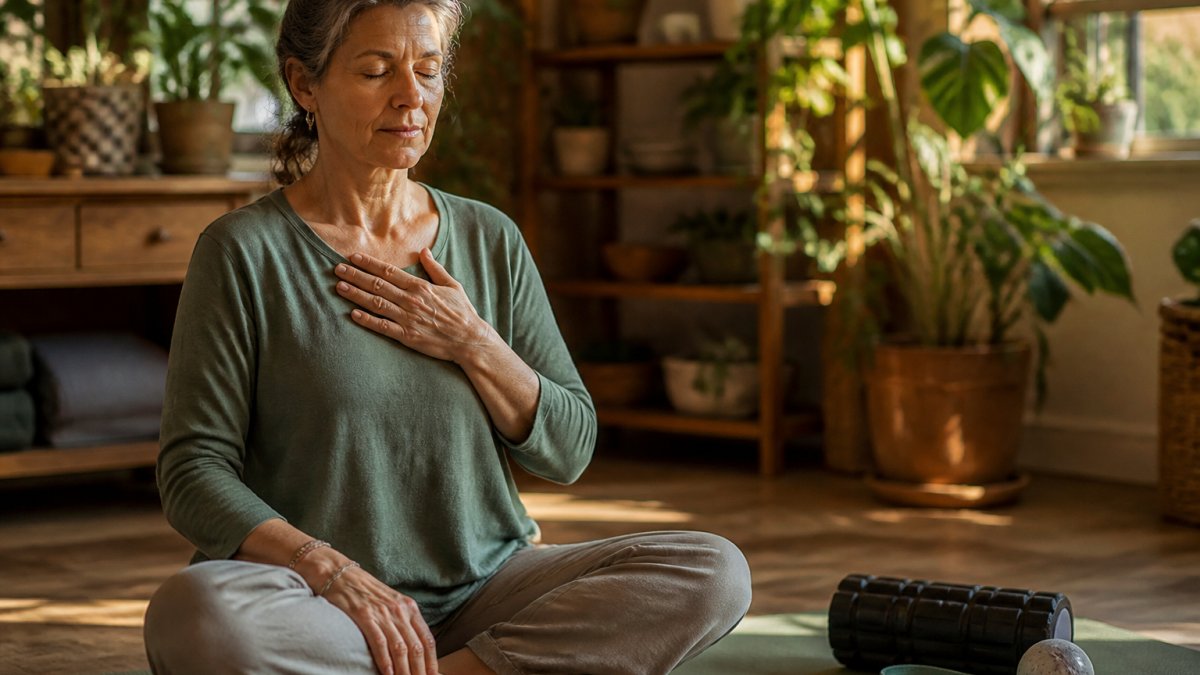
Lie down or sit back. Move your attention down through your jaw, shoulders, ribs, belly, hips, and legs. Where you find holding, breathe toward it and let it soften, or leave it alone.
Choosing the Right Technique for Your Stress Response and Symptoms
The harder question is which technique fits the body you have right now. If your schedule is packed, this curated guide to the best somatic practices for busy women can help you choose.
Start with what your body is doing, not what sounds appealing.
If your body feels... | Try this first | Time needed | Why it fits |
|---|---|---|---|
Wired, heart racing, breath high in the chest | Slow breathing with a longer exhale | 2-3 minutes | Gives you a voluntary handle on a response that usually runs on its own |
Braced and guarded, shoulders up, jaw set | Gentle somatic moves | 5 minutes | Small, slow movement interrupts guarding without adding load |
Tight but you cannot locate it | Body scan | 5-10 minutes | Builds the discrimination you need before you can change anything |
Widespread holding, hard to settle at night | Progressive muscle relaxation | 8-12 minutes | The tense-and-release contrast is easier to feel than pure observation |
Restless, unable to sit still | Walking or gentle mobility | 10 minutes | Movement gives the arousal somewhere to go |
Stiff from a long day at a desk | Self-myofascial release with a soft tool | 5-10 minutes | Temporary improvements in perceived tightness and range of motion are reasonable to expect (Effects of Self-Myofascial Release on Athletes’ Physical Performance: A Systematic Review) |
A body-first sequence for acute stress. When you are in the middle of it, order matters more than variety. Try this short progression:
- Minute 1: Exhale longer than you inhale. Four in, six out, five rounds. If counting makes you tense, just let the out-breath be slightly longer.
- Minutes 2-4: One or two somatic moves. A slow shoulder roll with a pause, then a gentle head turn. Half your normal speed.
- Minutes 5-6: A brief body scan. Sweep from jaw to hips and notice without correcting.
- Minute 7: Choose one thing to carry forward. A softer jaw, lower shoulders, or a slower breath. Pick one; do not try to keep all three.
That sequence is deliberately short. The goal is not to complete a routine but to interrupt a pattern long enough to notice a choice.
Adaptations when the standard version does not fit. Not every technique suits every body, and that is not a failure.
- If breath focus makes you more anxious: skip the counting and focus on a physical anchor instead, such as your feet on the floor or your back against the chair. Breath attention is not mandatory.
- If closing your eyes feels uneasy: keep them open with a soft gaze toward a fixed point.
- If lying on the floor is inaccessible or uncomfortable: do every technique seated, or standing with a hand on a counter for support.
If you want a guided starting point, Explore Calm Library's self-paced programs on self-myofascial release, body awareness, and gentle movement.
Frequently Asked Questions
What are body-based stress relief techniques, and how are they different from just relaxing?
Body-based stress relief techniques work directly on physical sensations rather than thoughts: slow breathing, gentle movement, progressive muscle relaxation, and body scans. They differ from passive relaxation because you actively engage with muscle tension and the stress response. For readers dealing with recurring neck and shoulder tightness, the physical focus is what makes these practices useful.
How long should I practice a somatic exercise or breathing exercise for stress relief?
Start with two to five minutes. Short, repeatable practice beats a long session you dread. Try five slow breaths before a meeting, or a two-minute body scan before bed. Consistency matters more than duration: a brief daily practice gives you more information about your tension patterns than one 45-minute session per week. If a technique feels good, extend it gradually. If it makes you tense or dizzy, stop and try a different approach.
What should I do if a movement makes my pain worse?
Stop the movement. Mild stretching sensation is fine, but sharp, shooting, or worsening pain is a signal to back off. Reduce the range, slow down, or switch to breathing instead. Persistent, worsening, or unexplained symptoms, especially with numbness, weakness, or pain that wakes you, warrant evaluation by a qualified healthcare professional. Body-based techniques are a self-care tool, not a substitute for diagnosis.
Can body-based techniques help with recurring muscle tension in my neck and shoulders?
They can help you notice and temporarily reduce perceived tension, which is often enough to change how you move the rest of the day. Combining breathing exercises for stress relief with gentle somatic movement and a body scan for tension gives you several ways to interrupt the cycle. Explore Calm Library for guided, self-paced practices.
Recurring tension isn't a discipline problem. It's a pattern worth understanding, and small daily practice changes more than occasional long sessions.
Calm Library offers short, self-paced programs that combine gentle self-myofascial release, body awareness, and movement, built for busy schedules. Start with one technique above, then explore the library when you're ready for more.
Get started with Calm Library and give your body a gentler way to let go.