
 blog
How to Decide if Somatic Movement Is Worth It for You
Last Updated: October 31, 2026
Quick Summary
Somatic movement is worth trying if recurring tension has not responded to stretching alone, since it costs little to start and mainly asks for attention and consistent practice. Give it four to six weeks of short, regular sessions before judging whether it helps you.
- Somatic movement uses slow, gentle motions and focused attention rather than forcing a release.
- A first session can be five to ten minutes of noticing sensations lying on a mat.
- Start with five to ten minutes whenever it fits comfortably into your routine. There's no established ideal frequency.
- Somatic exercises emphasize body awareness and movement coordination, while stretching typically focuses on improving range of motion and flexibility.
- Stop if a movement causes sharp pain, numbness, or dizziness, and seek evaluation for worsening symptoms.
Table of Contents
- What Somatic Movement Actually Is (and What It Isn't)
- Somatic Exercises for Beginners: What a First Session Looks Like
- Somatic Movement vs Stretching: Why the Difference Matters
- Is Somatic Movement Worth the Time and Cost?
- Frequently Asked Questions
What Somatic Movement Actually Is (and What It Isn't)
Is somatic movement worth it? For many women with recurring neck, shoulder, or hip tension, yes, with realistic expectations. Somatic movement is a slow, body-based approach using focused attention and small, gentle motions to help you notice and change habitual movement patterns. It is not stretching harder or forcing a release.
At Calm Library, we hear from women who have stretched, massaged, and exercised for years while the same tight spots keep returning. Somatic exercises ask a different question: what is your body doing all day that keeps recreating that tension?
Research on somatic approaches is still developing. A review of Somatic Experiencing research suggests potential benefits for certain symptoms, but Somatic Experiencing is a specific therapeutic approach, not the same as everyday somatic movement exercises. We still need more research to understand how effective short, self-guided movement practices are for recurring tension.
That distinction matters. Somatic movement is not the same as somatic therapy, a clinical modality delivered by a trained practitioner, often for trauma or PTSD support. It is also not talk therapy, and it is not a cure for chronic pain.
Somatic Exercises for Beginners: What a First Session Looks Like
A first somatic session is short, quiet, and surprisingly uneventful. You lie on a mat, close your eyes, and spend five to ten minutes noticing sensations: where your ribs move, where your back meets the floor, where your jaw holds on.
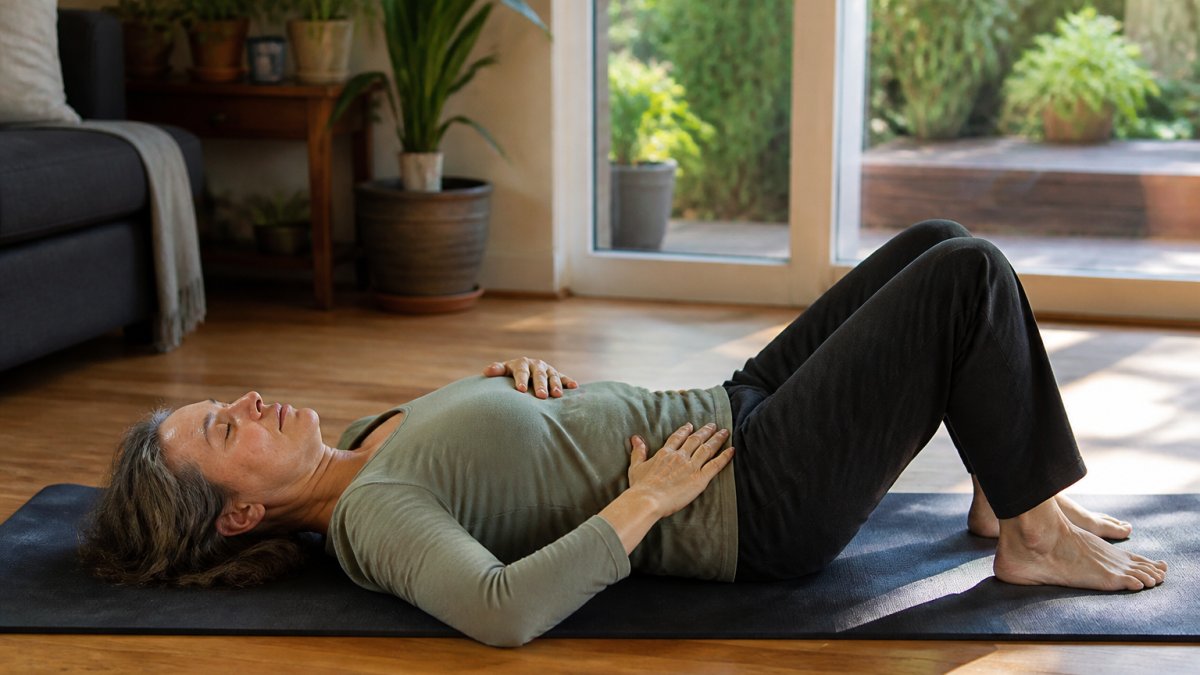
Here is a simple sequence you can try at home:
- Lie on your back with knees bent, feet on the floor.
- Spend one minute noticing contact points: heels, pelvis, ribs, head.
- Slowly press one heel into the floor, then release. Repeat five times.
- Notice whether the other leg responds.
- Roll your head gently side to side, no forcing.
- Finish with three slow breaths and stand up slowly.
That is it. No burning, no stretching to the edge. If you want a concrete starting point, try the short sequence above before bed.
How often should you practice? Start with five to ten minutes whenever it fits comfortably into your routine. There's no established ideal frequency. If you are weighing the time commitment, read about whether short somatic sessions can reduce stress. Try it consistently for a few weeks, notice how your body responds, and adjust based on what feels useful.
Watch out: if a movement causes sharp pain, numbness, or dizziness, stop. Persistent or worsening symptoms deserve evaluation by a qualified healthcare professional.
Somatic Movement vs Stretching: Why the Difference Matters
Stretching and somatic movement aren't opposites. Both can improve movement awareness and comfort, depending on how they're practiced.
Traditional stretching often focuses on exploring or increasing range of motion. Somatic movement places greater emphasis on noticing sensations, effort, and habitual movement patterns through gentle, comfortable movements.
Neither approach is inherently better. If stretching hasn't provided lasting relief, exploring how you move and hold tension throughout the day may offer another useful perspective.
If you also practice yoga, our breakdown of somatic movement vs regular yoga explains where the two overlap and where they diverge.
A quick comparison:
Approach | What It Targets | Typical Pace | Best For |
|---|---|---|---|
Somatic movement | Body awareness, movement patterns | Very slow | Recurring tension, retraining habits |
Static stretching | Range of motion and stretch tolerance | Held 20-60 seconds | Short-term flexibility |
Yoga | Strength, mobility, breath | Moderate | General mobility and calm |
Somatic therapy | Trauma, nervous system | Talk and body-based | Clinical support with a provider |
Is Somatic Movement Worth the Time and Cost?
For most readers, somatic movement is worth trying if recurring tension has not responded to stretching alone. It costs little to start: you need a mat and ten minutes. The main investment is attention and consistent practice.
Formal somatic therapy requires a qualified provider, and fees depend on the practitioner and your location, so ask directly rather than assuming.
The honest limits: evidence is preliminary, results are gradual, and no approach works for everyone. Give it four to six weeks of consistent short practice before judging.
That is the case for curiosity over force. Explore Calm Library to learn gentle self-myofascial release, body awareness, and movement at your own pace, and discover a gentler approach to recurring tension.
Frequently Asked Questions
Can somatic movement help with recurring muscle tension?
It may help, though the evidence is early and studies on somatic movement remain limited. Think of somatic movement as a low-risk way to explore tension patterns, not a guaranteed fix for tight neck, shoulders, or hips.
How is somatic movement different from stretching?
Stretching usually takes a muscle to its end range and holds it. Somatic movement vs stretching comes down to attention: somatic exercises use slow, small movements paired with focused attention on how the motion feels, so you're retraining movement patterns rather than lengthening tissue. That's why the goal isn't a deeper stretch but more awareness of where you hold tension and how to let it go without forcing.
Is somatic movement safe for beginners, and how often should you practice?
Gentle somatic exercises are generally low-risk for beginners. Start with five to ten minutes of slow, comfortable movement and a short body scan, and stop if anything sharpens or spreads. There's no established dosage, but many people practice most days in short sessions rather than one long weekly one. If you have persistent, worsening, or unexplained symptoms, check with a qualified healthcare professional before starting.